
It shows that states would require a compensation to the tune of at least Rs 1.67 trillion in 2024-25, as none of them would be able to achieve a 14 per cent growth every year.

Hospitals empanelled for Modicare may give preference to poor patients over the middle class for fear of strict government action, says Harsh Roongta.

Raghuram Rajan is said to have informally written to select policymakers and experts, to curb 'unnecessary' speculation over his future at RBI.
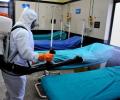
'Most of the testing capacity in India is in the private sector.' 'Whether it is the established RT-PCR test for COVID-19, or it is other innovations in testing that are now coming up, all these are fully within the capabilities of the private sector.' 'Health policy should harness these capabilities,' says Ajay Shah.

Officials said the government had no option but to cut spending.

Without bringing sound governance and technical capabilities into the RBI's work, injecting new money sets the stage for a next wave of bad behaviour by banks, warns Ajay Shah.

Over 15 years, with seven per cent growth, the Indian economy will be three times bigger.

'There are many things we need to work on.' 'At the heart of it is, one, the extent of inequality, which is not good for democracy and nation; two, a structural decline on how a country ought to function, how people should be held accountable, whose role is what.'

In a first, the Comptroller and Auditor General's (CAG) officers reached out to several ministries in the last week of April as part of a confidence-boosting measure. The meeting brought the CAG officials and those from the ministries across the table to discuss the pain points in their relations. CAG of India Girish Chandra Murmu took this novel step because of growing tensions between those audited and the auditor.

The Centre has constituted a five-member expert committee to study various alternatives available to it to decide on a new capital for Andhra Pradesh.
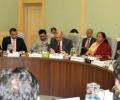
At a pre-Budget meeting, the FM was asked to ensure that NBFCs come out of the liquidity crisis they are facing with the help of RBI. They also spoke about the futility of trying to achieve a 3 per cent fiscal deficit target over the medium term.

'For a responsible person like him to utter such nonsense is shameful.' 'He is not fit to be a director on the RBI central board.'
Bankers said the mammoth task of cleaning up the PSBs and improving their health will be a mammoth task for any chief executive.
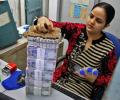
'The Budget numbers presented severely underestimate the magnitude of the unstated fiscal crisis that we went through in 2018-2019, which cannot be conceivably be fully reversed in 2019-2020,' points out Rathin Roy, director, National Institute of Public Finance and Policy.

The Budget is remarkably coherent.
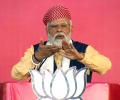
Modi's BJP has promised more revdis or freebies for these assembly elections than ever before, points out N Sathiya Moorthy.
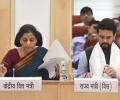
If the protected growth in GST revenue is reduced to 10 per cent, the Centre would save more than Rs 25,000 crore in 2020-21 if none of the states show any revenue growth. This would nearly amount to 0.1 per cent of the gross fiscal deficit and help the government in avoiding fiscal slippage to some extent in subsequent years.

The finance minister asked lenders to identify eligible borrowers and reach out to them and urged for quick implementation of a sustained resolution plan for the revival of every viable business.

Last week, a Rajya Sabha committee had allocated five hours for discussion on GST.

The pipeline for well-qualified and experienced policy economists at senior levels of government has broken, leading to a growing dearth of suitable candidates for top economist positions.
'The hour is very late, and the choice between triumph and tragedy knocks at our door,' says Ajay Shah.

The Centre has to bear the maximum burden of borrowing NSSF loans to the tune of Rs 1 lakh crore.

In its essence, GST is a national level system of value added taxation of goods and services, says Shankar Acharya.

'Given the possibility that our unstable northern and western borders may become 'live' at short notice, any major systemic change which impacts combat effectiveness should be brought about in a cautious and progressive manner.'

But it is disappointing to note that Sitharaman's third Union Budget continues to promote a few problematic ideas, observes A K Bhattacharya.

Modi had campaigned with promises of jobs, infrastructure and development.

India's macroeconomic situation is certainly better than what it was a year ago, eminent economist Pinaki Chakraborty said on Monday, while expressing hope that the country will be back on the path of economic growth if there is no major third wave of the COVID-19 pandemic. In an interview with PTI, Chakraborty, who is the director of the National Institute of Public Finance and Policy (NIPFP), said that inflation may remain at an elevated level as there was a significant fiscal and monetary expansion in the last 18 months. "The current macroeconomic situation is certainly much better than what it was one year back. We are seeing recovery in most sectors," he said. Chakraborty noted that COVID-19 vaccination has been going on at a very fast rate in India.

The demand for OROP has been projected as an unambiguous issue but a good policy argument must have a sound economic element.

The current salary paid by the Delhi government amounts to 17 per cent of the total expenditure.

A Parliamentary Standing Committee praised the government for the wrestling and boxing facilities at the Sports Authority of India's Sonepat Center but pointed out that "excellence needs to be replicated for other sports disciplines".

Stepped up public expenditure must be accompanied by focused policies, advises Vinayak Chatterjee.

The speed at which he led the central bank in different areas -- ranging from internal reorganisation to inflation fighting, stabilising the currency, taking on rogue corporations, cleaning up bank balance sheets, and opening the sector -- makes one believe that Rajan knew he had only three years to do his job. A fascinating excerpt from Tamal Bandyopadhyay's MUST-READ Roller Coaster: An Affair with Banking.
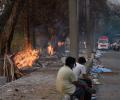
Shortage of ICU beds, oxygen, ventilators, vaccines, doctors, nurses and crematorium space in India has dominated headlines around the world in the past few weeks with Covid-19 cases surging beyond control and the government failing to deliver. Yes, election rallies, Kumbh Mela, blatant flouting of social distancing and mask protocols coupled with a messy vaccination process are said to be responsible for the health crisis of colossal proportions that India is facing today. But an analysis of Budget speeches made by finance ministers over 75 years also offers a glimpse of how low on the priority list healthcare has featured for the political class and policy-makers, which is a significant reason for the current situation.

Courts in five countries including the US and the UK have given recognition to an arbitration award that asked India to return $1.4 billion to Cairn Energy plc - a step that now opens the possibility of the British firm seizing Indian assets in those countries if New Delhi does not pay, sources said. Cairn Energy had moved courts in nine countries to enforce its $1.4 billion arbitral award against India, which the company won after a dispute with the country's revenue authority over a retroactively applied capital gains tax. Of these, the December 21 award from a three-member tribunal at the Permanent Court of Arbitration in the Netherlands has been recognised and confirmed by courts in the US, the UK, Netherlands, Canada and France, three people with knowledge of the matter said.

The branch managers have come out of their glass cabins and the sellers' market has transformed into a buyers' market, but there is no end to the harassment of customers, asserts Tamal Bandyopadhyay.
Data on the new series given by a panel on real sector statistics shows that GDP grew by 10.23 per cent in 2007-08 and 10.78 per cent in 2010-11. There are some years for which the new figures show a deceleration in growth as well. The new series has 2011-12 as the base year while the earlier series had 2004-05 and 1993-94.

NITI Aayog had been asking for Rs 7,500 crore for three years to set up an AI framework.
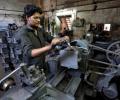
The fall in investment rate is not surprising. But putting it together with rising share of wages in GVA, it shows that the focus is more on productivity, rather than adding new capacity, says Pronab Sen, former chief statistician of India.

energy is India's binding supply-side constraint for inclusive growth.

'If some measures are implemented quickly, they can help revive growth.'
